Four contexts encompass most situations related to the environmental licensing of road works: (a) construction of a new road; (b) paving of existing unpaved roads; (c) capacity expansion through the construction of additional carriageways alongside already paved roads; and (d) environmental regularization of roads that are already in operation (Figure 4).
The scope for intervention within an environmental licensing process varies considerably among these situations. Factors such as construction costs, traffic functionality, and socioeconomic conditions already established around an existing alignment can make the adoption of alternative routes difficult. The greatest opportunity to minimize impacts occurs when a new road is planned, because the route-selection stage allows the most ecologically sensitive areas to be avoided, particularly in terms of conservation status and the extent of native vegetation (CALTRANS 2009). This should be based on a baseline assessment of the physical and biotic environments, including characterization of the regional conservation context and cartographic analysis of these factors; assessment of the feasibility of multi-use corridors (for example, roads combined with power-transmission infrastructure); environmental impact assessment; and, finally, selection of the least-impacting alternative among those available (BANK et al. 2002).
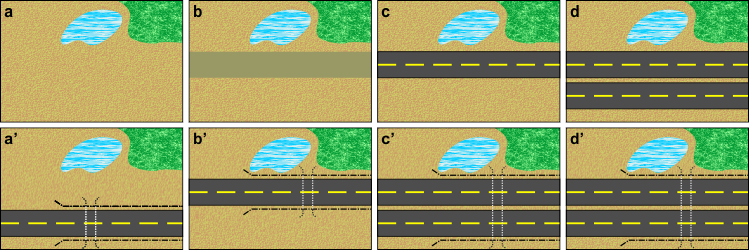 Figure 4. Schematic representation of the types of intervention commonly considered in the environmental licensing of road works: a–a′ = new road construction (before and after); b–b′ = paving (before and after); c–c′ = capacity expansion or duplication (before and after); d–d′ = regularization of roads already in operation. Although changes to existing alignments may be possible in order to reduce impacts on water bodies or vegetated areas, existing degradation is often difficult to reverse.
However, most current interventions involve paving road sections that are already established and expanding the capacity of paved single-carriageway roads through the construction of additional lanes or carriageways. Environmental regularization of roads built before the 1980s—when environmental licensing became a legal requirement—also tends to play an increasingly important role in the assessment of impacts on wildlife.
In these cases, the possibility of changing the alignment is generally limited, and mitigation therefore depends to a greater extent on identifying priority road sections and selecting measures that reduce mortality, maintain connectivity, and address the specific environmental effects associated with the existing road.
Regardless of the type of project, environmental assessment should begin as early as possible in the planning process. Incorporating ecological information only after the engineering design has been consolidated greatly reduces the range of feasible alternatives and may increase both environmental impacts and mitigation costs.
Translation note: This English version was preliminarily translated using ChatGPT and has not yet undergone human review.