1.4. ENVIRONMENTAL IMPACT ASSESSMENT: DECISION-MAKING
Assessing how significant an environmental impact is necessarily involves a degree of subjectivity, because the extent to which an environmental change (impact) can be tolerated depends greatly on the values and concepts of those analyzing the situation (SÁNCHEZ 2008). “How many deaths can a species sustain without significant consequences for its conservation?” is an essential biological question when evaluating the need for and degree of mitigation required for a road project, but it is difficult to answer (SEILER & HELLDIN 2006).
In addition to the strictly biological perspective, legal, economic, traffic-safety, ethical and environmental-policy factors must also be considered (SEILER & HELLDIN 2006). Although all of these aspects should be weighed in decision-making, this guide focuses primarily on impact assessment and decision-making from biological and ecological perspectives, probably the perspectives associated with the greatest uncertainty and relevance. A baseline assessment containing objective, reliable qualitative and quantitative information greatly facilitates decisions during road licensing, when the environmental authority must determine which measures should be adopted to avoid, mitigate or compensate for environmental damage. Where impact avoidance is technically and economically feasible, the impact should theoretically not occur, and monitoring of project operation should be sufficient to verify the effectiveness of the selected alternative. For unavoidable impacts, environmental compensation—required under legislation for licensing processes based on an Environmental Impact Assessment (EIA) and funded by the project proponent—provides the corresponding offset for the damage.
Once project data and baseline information supporting the preliminary licensing analysis have been assembled, the licensing authority should be able to verify whether priority road sections, wildlife groups of concern and the magnitude of impacts on wildlife have been correctly identified, and whether the most appropriate mitigation measures have been proposed. Beyond the specific project under review, the environmental manager must place it in the context of the broader road network, the condition of regional ecosystems and the conservation status of species. The environmental authority should maintain a consistent Geographic Information System, both to verify information presented in environmental studies and to provide a broader-scale framework within which the project can be assessed. Useful information available from different sources includes digital elevation models (Shuttle Radar Topography Mission data are freely available from NASA), hydrological and vegetation maps, priority areas for biodiversity conservation, and existing road networks.
From a biological perspective, the main questions to be answered during decision-making (Figure 9), based on the information gathered and accumulated knowledge, are:
a. What is the expected magnitude of impacts on wildlife?
b. Can the impacts be classified spatially and temporally?
c. Which measure is most appropriate to achieve mitigation?
d. What is the actual impact of the road, and how effective are the measures adopted?
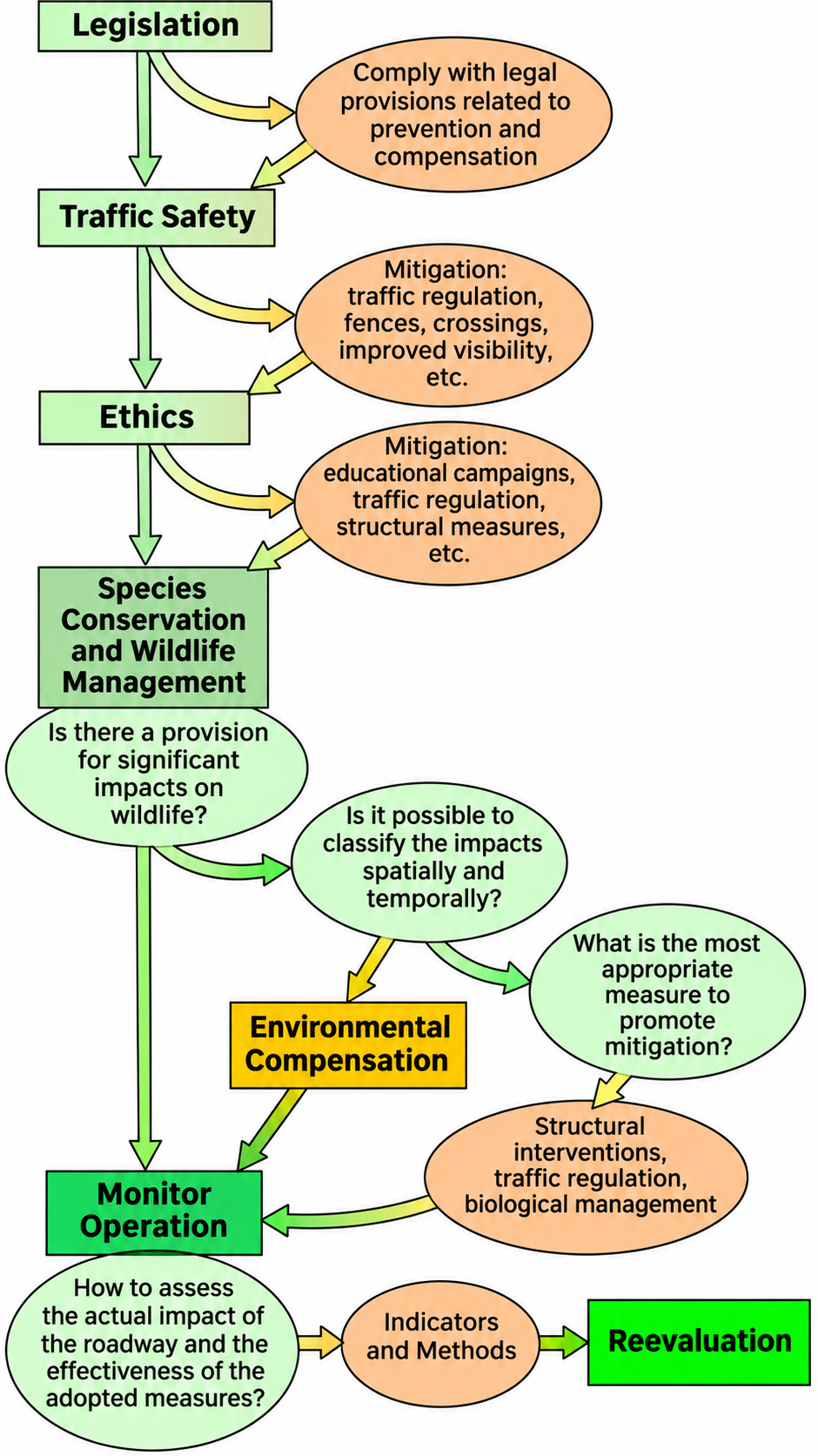 Figure 9. Basic decision-making flowchart for road impacts on wildlife, emphasizing the biological perspective. Except for the legal perspective, the other perspectives (safety, ethics and biology) are not arranged hierarchically. |
Once the first two questions have been answered, the most effective measure for reducing impacts on wildlife should be defined. Experience accumulated over recent decades and reported in the literature indicates that some known alternatives perform better for particular animal groups or topographic conditions, whereas others have cost–benefit relationships that are disproportionate to the expected impact. Section 2. Mitigation measures describes and indicates alternatives identified through an extensive literature review. All professionals involved in the process—consultants, contractors and environmental managers—should be familiar with their characteristics.
Before selecting an appropriate structure or device, the mitigation strategy must first be defined according to the most relevant expected effects. Research in road ecology should support this decision. For example, simulations by JAEGER & FAHRIG (2004) identified mortality as a determining component of population persistence. The review by FAHRIG & RYTWINSKI (2009) found that reptiles, amphibians and large mammals were among the main animal groups showing negative road effects on abundance, with mortality playing a major role in population decline. Reduced genetic diversity has likewise been reported to be significantly associated with mortality rather than barrier effects (JACKSON & FAHRIG 2011). Avoiding mortality can therefore be regarded as a priority mitigation strategy. At the same time, the original permeability of the environment should be restored as far as possible so that ecological processes occur with minimal interference from the road.
Connectivity and permeability are also central concepts in planning mitigation for road impacts on wildlife. Among the definitions discussed by COLLINGE (2009), HILTY et al. (2006) and LINDENMAYER & FISCHER (2006), connectivity can be understood as a landscape-based concept referring to the physical structures that allow movement between habitats. Permeability adds an animal-based perspective and concerns the routes and movement patterns characteristic of different species. Thus, even where physical structures provide connectivity, they may fail to provide permeability if the location, type and configuration of those structures do not reflect the characteristics of the wildlife community for which they are intended (BISSONETTE et al. 2007). The selection of mitigation measures must therefore be grounded in an adequate baseline assessment, following the recommendations in Section 1.2. Environmental baseline assessment.
In road ecology, the habitat fragments under consideration are generally close to one another, so the problem may initially appear less complex than establishing connections between distant fragments, where a corridor must provide habitat capable of supporting communities rather than merely serving as a passage route. For short connections such as wildlife crossings intended to mitigate road-induced fragmentation, it may be sufficient for structural characteristics—such as slope, width and height, identified as particularly important by AHERN et al. (2009) and CLEVENGER & WALTHO (2005)—to permit animal movement. The structure should also avoid characteristics that discourage use, including unsuitable light, vegetation cover, noise, humidity, temperature or substrate, and its location should be compatible with the habits and movement patterns of the target species.
Different actions should be considered depending on the level of biological organization being addressed (for example, target species or the broader community) and the effects to be mitigated. If reducing or eliminating wildlife–vehicle mortality is the principal objective, barriers such as fences, walls or curbs may be more important than providing crossings. If access to vital habitats must be maintained, crossings usable by a broad range of species may be the best alternative. If fragmentation threatens the maintenance of minimum home-range requirements, crossing opportunities should allow individuals access to an area compatible with their ecological needs. If the objective is only to maintain metapopulation dynamics—which may require movement of only a small number of individuals per generation—AHERN et al. (2009) suggest that this may sometimes occur even without dedicated crossing structures. However, because some roads can strongly inhibit even this minimum level of movement, measures should be provided to increase the probability of successful crossings.
Except in particular circumstances, several basic principles should guide decisions: selected locations should have topographic features suitable for wildlife movement; structures should be usable by the greatest possible number of species; the habitats being connected should have prospects for long-term conservation; and they should form part of a broader corridor network (BECKMANN et al. 2010).
Decision-making should therefore be clearly grounded in the answers to the questions above, specifying the objectives of the proposed measures and how and where they should be implemented. In addition, as discussed in Section 3. Monitoring, a methodology must be established to assess their effectiveness, giving the process the desired adaptive character through continuous reassessment and, where necessary, adjustment.