1.3. ENVIRONMENTAL IMPACT ASSESSMENT: KNOWN IMPACTS
Road construction has two major impacts on wildlife: individual mortality and the barrier effect (BECKMANN et al. 2010; SEILER 2001), as schematically represented in Figure 8.
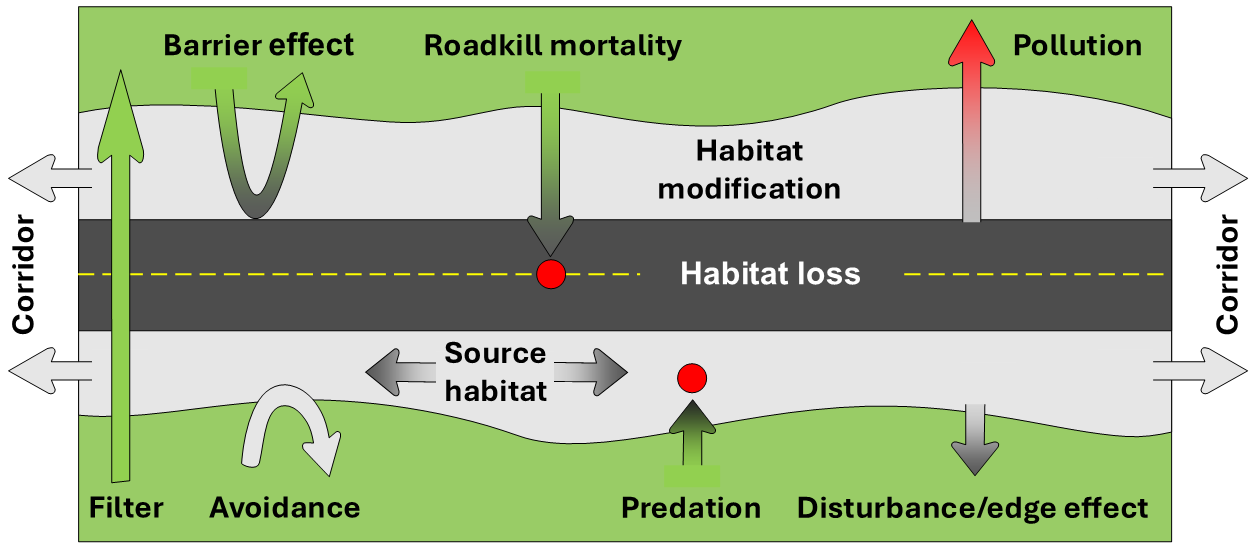
Figure 8. Schematic representation of the ecological impacts of roads. Together, these effects result in habitat fragmentation. Adapted from Seiler (2001).
In addition to these, numerous other effects can be identified (TROMBULAK & FRISSELL 2000) and classified in different ways, considering, for example, the nature of the impact (direct or indirect), the affected environmental component (physical, biotic or socioeconomic), or the level of biological organization (individuals, populations or metapopulations). Classifying a given impact as direct or indirect involves some degree of subjectivity, because many effects have characteristics that could place them in either category. Since all impacts must be considered within environmental licensing, the classification scheme itself is of secondary importance. The approach adopted here therefore emphasizes impacts on the biotic environment, together with selected effects on the physical and socioeconomic environments that, in turn, affect animal groups. The main effects are summarized in Table 3.
Table 3. Main environmental effects and impacts of roads on wildlife.
| Environmental activity or aspect | Environmental impact |
| Traffic | Mortality of individuals. |
| Physical road infrastructure | Direct habitat loss. |
| Physical road infrastructure | Creation of new habitats, refuges and dispersal corridors within the road right-of-way. |
| Physical road infrastructure | Fragmentation: dividing a habitat through road construction creates two fragments with smaller core areas and a greater proportion of edge habitat, driving some species away while attracting others (SPELLERBERG 2002). Initially, spatial structuring of genetic variation may occur, followed by reduced genetic diversity, which can decrease population viability (BALKENHOL & WAITS 2009). Smaller subpopulations are also more vulnerable to environmental pressures. At the individual level, fragments may be smaller than the species’ typical home range and therefore fail to provide the conditions required for survival. |
| Physical road infrastructure and traffic | Loss of connectivity (movement routes between habitats). |
| Physical road infrastructure and traffic | Reduction or loss of permeability (movement between habitats). |
| Physical road infrastructure and traffic | Barrier effects: reduced movement of individuals between habitats and, consequently, reduced gene flow, increasing inbreeding and leading to loss of genetic diversity (ASCENSÃO & MIRA 2007). Components include road avoidance, lack of suitable crossing locations, and roadkill when animals attempt to reach the opposite side (BANK et al. 2002). Elimination of physical routes represents loss of connectivity, whereas difficulty in establishing viable routes between habitats represents loss of permeability. This impact also applies to fish: if migratory species cannot pass through artificial drainage structures, fishery resources may decline. |
| Physical road infrastructure and traffic | Edge effects: changes in habitat characteristics such as temperature, humidity, solar radiation and wind (ATTADEMO et al. 2011). |
| Opening of colonization fronts and agricultural expansion | Direct habitat loss. |
| Physical road infrastructure and traffic | Dispersal of non-native species. |
| Increase in habitat edges | Changes in habitat quality. |
| Generation of particulate matter | Deterioration of air quality. |
| Noise emissions | Changes in wildlife behavior, particularly in birds. Communication may be affected, with consequences for courtship behavior and reproductive success (HALFWERK et al. 2011). Depending on traffic intensity, effects on birds may be detected up to 2.8 km from the road (SPELLERBERG 2002). Amphibians may alter their calling patterns in response to high traffic-noise levels, potentially affecting reproduction (CUNNINGTON & FAHRIG 2010). |
| Soil sealing and modification of drainage patterns | Changes in hydrological regimes. |
| Engine emissions and release of substances from tires and pavement | Water and soil contamination: concentrations of metals such as Pb, Ni, Cd and Zn may increase up to 30 m from the road in soils, 40–120 m in plants and up to 48 m in animals (SPELLERBERG 2002). |
| Erosion and sediment transport | Changes in aquatic habitats. During construction, landslides and soil disturbance—as well as unpaved roads or degraded embankments—can deliver substantial sediment loads to aquatic systems. By directly increasing turbidity and disturbing these ecosystems, sediments may affect sensitive areas up to 89 m from the road (SPELLERBERG 2002). |
| Artificial lighting | May attract various forms of wildlife and alter temporal activity patterns in birds (SPELLERBERG 2002). |
| Vehicle vibration | Wildlife displacement and avoidance. |
| Litter disposal | In addition to causing fires and contaminating habitat, bottles and cans may become traps for small mammals, snakes and lizards (SPELLERBERG 2002). Conversely, they may also provide shelter for these groups and for birds. |
| Accidental contamination by hazardous chemicals | Mortality, particularly among aquatic species. Accidents involving vehicles transporting hazardous substances, followed by contamination of watercourses and nearby habitats, are an unavoidable risk on most roads where such transport is permitted. |
The geographic extent (the “road-effect zone”) and intensity of road impacts vary according to factors such as road type (number of carriageways and traffic lanes), traffic volume, vehicle speed, and the biological group being considered. A multi-lane road with heavier traffic may show lower wildlife mortality than a two-lane road with lighter traffic because animals may be less likely to approach it, reducing permeability. Both roads can therefore produce a barrier effect, although through different components. Brockie et al. (2009), for example, reported an increase in road-killed animals up to approximately 5,000 vehicles/day; above that level the trend did not persist, possibly because animals avoided the road. Responses to these factors, however, are not identical among animal groups. Bissonette & Rosa (2009), for example, found no variation in habitat presence and use along a 600-m gradient perpendicular to a road for small-mammal communities in arid environments.
Reliable population-level and behavioral information is unfortunately available for only a small number of species, most of them not native to Brazil (Fahrig & Rytwinski 2009). Increasing road density or traffic may, for example, be associated with increases in populations of small rodents (Rytwinski & Fahrig 2007) and decreases in populations of wetland anurans (Carr & Fahrig 2001; Eigenbrod et al. 2008). In the first case, possible explanations include road avoidance, road-related habitat changes, or reductions in predator abundance; in the second, mortality associated with increased traffic is the main component.
The distance over which roads significantly affect ecosystems also varies among animal groups, from approximately 200 m for sedentary species to more than 2,000 m for turtles, crocodilians, and amphibians (Aresco 2005). More mobile species may be especially susceptible to wildlife–vehicle collisions (Carr & Fahrig 2001).
Roads attract a large and diverse range of animals. Ectotherms use heat stored in pavement; herbivores feed on vegetation growing within the right-of-way; birds consume grain spilled from poorly sealed trucks (Erritzoe et al. 2003); amphibians and reptiles may use road embankments and verges for nesting (Aresco 2005; Seiler 2001); fossorial mammals may excavate burrows there—sometimes even compromising the road base, as occurred with ctenomyids along RSC-101 (Estrada do Inferno)—and scavengers feed on road-killed wildlife (Antworth et al. 2005).
The relatively few studies conducted in South America—including Brazil (Bager & Rosa 2010, 2011; Cherem et al. 2007; Coelho et al. 2008; Cunha et al. 2010; Gumier-Costa & Sperber 2009; Pereira et al. 2006; A. O. Rosa & Mauhs 2004; C. A. Rosa & Bager 2012), Argentina (Attademo et al. 2011), Colombia (Arroyave et al. 2006), and Venezuela (Pinowski 2005)—highlight the shortage of information on road impacts on regional wildlife. At a time of economic development and expansion of transportation infrastructure, additional studies of South American wildlife are particularly important. The literature from the United States, Europe, and Australia is extensive and addresses many factors and animal groups that are comparable to those in South America. Large mammals, however, are substantially more frequent in the United States, with more severe traffic-safety and economic consequences. An estimated 1.5 million deer–vehicle collisions occur there each year (about three quarters of all animal–vehicle collisions), resulting in approximately 210 human deaths annually and US$1.1 billion in vehicle damage (Sullivan 2011). In Brazil, collisions with medium- and large-sized wild animals become particularly relevant in specific situations, such as the section of BR-471/RS crossing the Taim Ecological Station, where capybara (Hydrochaeris hydrochaeris) collisions are frequent.
Small and large mammals respond differently to roads. Large mammals are more strongly affected by increased hunter access and habitat reduction, whereas smaller mammals are particularly affected by road mortality and restrictions on movement (Spellerberg 2002).
Climate variables such as temperature and rainfall, as well as seasonality, influence roadkill rates because animal activity patterns and traffic volumes change over the life cycle and throughout the year. Amphibians and reptiles that undertake mass movements during reproductive periods are characteristic examples of seasonal variation in road mortality (Aresco 2005; Cureton II & Deaton 2012), and season-specific mitigation measures have been recommended (Barker 2009). In Argentina, Attademo et al. (2011) found significant relationships between increased temperature and rainfall—corresponding to spring and summer—and roadkill rates of reptiles and amphibians. Similar phenomena occur in Brazil, including increased movement of the D'Orbigny's slider (Trachemys dorbignyi) on roads crossing suitable habitat, such as BR-392 in Rio Grande, Rio Grande do Sul. Such observations cannot be generalized and should be evaluated specifically for the animal groups and environments concerned.
Where roads cross wetlands, impacts on herpetofauna may be especially severe because many species move slowly (Ahern et al. 2009; Hels & Buchwald 2001), show limited road avoidance (Bouchard et al. 2009), encounter physical barriers during reproductive or hydrologically driven migrations (Beaudry et al. 2008, 2010; Spellerberg 2002), and may be attracted to open roadside areas as nesting habitat (Aresco 2005). Turtle mortality exceeding 5% of the population probably occurs in several regions of the United States, above the estimated 2–3% mortality threshold that turtle populations can absorb while maintaining positive population growth (Gibbs & Shriver 2002). On a heavily trafficked four-lane road—similar to the configuration used in many Brazilian road duplications—the probability of a turtle successfully crossing may be only about 2% per attempt, with 95% of individuals being struck in the first lane adjacent to the shoulder (Aresco 2005).
In a study conducted in Argentina, amphibians were by far the group most affected by road mortality, accounting for 72.92% of 2,024 road-killed animals, followed by reptiles (14.97%), birds (7.88%), and mammals (4.25%). Amphibians and reptiles were most affected where roads crossed wetlands, birds in forested areas, marsupials and bats in urban areas and their surroundings, and mammals in heterogeneous landscapes (Attademo et al. 2011).
Drainage structures such as culverts may retain their hydrological function while still preventing passage by some or all fish species (Belford & Gould 1989). Vertical drops, insufficient light, water velocity, and water depth may create obstacles that certain species or juvenile life stages cannot overcome. Even for non-migratory species, inability to move upstream or downstream across a road can isolate populations and may even lead to local extinction when seasonal drought affects one of the isolated reaches (Baker & Votapka 1990). Conversely, drainage structures along roads can create new habitats for amphibians, and some species may benefit from roads as dispersal routes (Forman & Alexander 1998).
As in other animal groups, reductions in forest-habitat area caused by fragmentation reduce available resources for birds and are positively associated with declines in the abundance and diversity of forest-interior species. Edge species may be favored, while nest predation and brood parasitism increase, reducing reproductive success. The abundance of some species may be affected at distances of approximately 200–1,200 m from a road, while edge species may be favored within roughly 100 m (Spellerberg 2002).
Bird mortality on roads reaches hundreds of millions of individuals annually, with passerines among the most affected groups. One ecologically relevant feature in fragmented populations is that road-killed individuals may be significantly healthier than individuals killed by natural predators, producing a pattern that differs from the usual forces of natural selection (Bujoczek et al. 2011; Erritzoe et al. 2003).
Partly because of differences in scale, many invertebrates—and even small mammals (McGregor et al. 2008)—simply do not enter roads, which may constitute a broad and inhospitable environment. This negative response to the physical road surface (“road surface avoidance”) is one of three components of road avoidance, together with responses to moving vehicles (“car avoidance”) and to traffic-related noise and pollutant emissions (“traffic avoidance”) (McGregor et al. 2008).
Road avoidance is one of the factors determining the intensity of the barrier effect, together with mortality from vehicle collisions. Snails are a characteristic example of avoidance of the physical road surface, which can isolate populations. Bees, butterflies, and spiders show similar behavior to a lesser degree (Spellerberg 2002), with potential consequences for plant populations that depend on insect-mediated pollination (Rao & Girish 2007). Although insect mortality on roads may appear high simply from observing vehicle windshields after travel (Forman & Alexander 1998), relatively few studies quantify it adequately (Rao & Girish 2007), and population-level consequences remain poorly established.
Translation note: This English version was preliminarily translated using ChatGPT and has not yet undergone human review.